
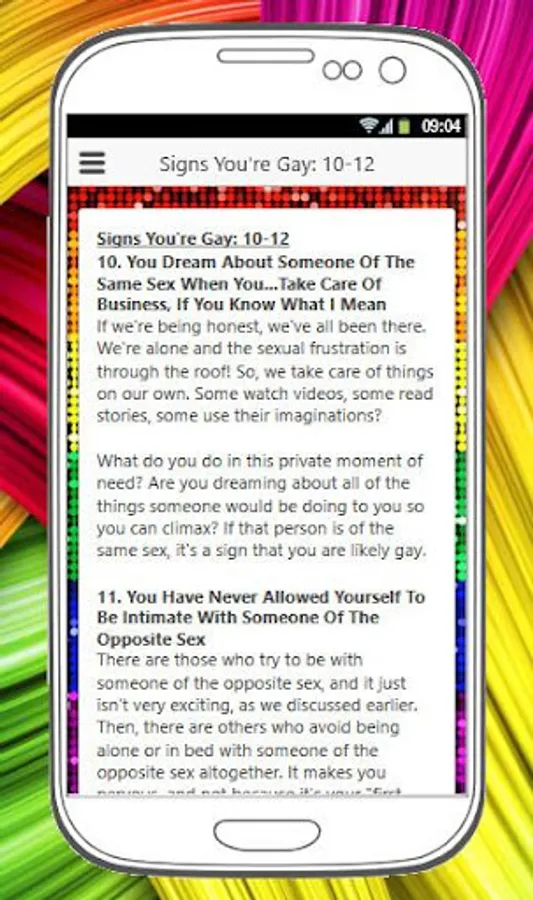
In this quiz app, you can assess your sexual orientation by answering questions about your feelings and attractions. Includes quizzes, result explanations, and privacy features.
AppRecs review analysis
AppRecs rating 2.7. Trustworthiness 0 out of 100. Review manipulation risk 0 out of 100. Based on a review sample analyzed.
★★☆☆☆
2.7
AppRecs Rating
Ratings breakdown
5 star
27%
4 star
17%
3 star
3%
2 star
3%
1 star
50%
What to know
✓
Authentic reviews
Natural distribution, no red flags
⚠
Mixed user feedback
Average 2.7★ rating suggests room for improvement
⚠
High negative review ratio
53% of sampled ratings are 1–2 stars
About AM I GAY
Am I Gay - Gay is a term that primarily refers to a homosexual person or the trait of being homosexual. The term was originally used to mean "carefree", "cheerful", or "bright and showy".
The term's use as a reference to homosexuality may date as early as the late 19th century, but its use gradually increased in the mid-20th century. In modern English, gay has come to be used as an adjective, and as a noun, referring to the community, practices and cultures associated with homosexuality. In the 1960s, gay became the word favored by homosexual men to describe their sexual orientation. By the end of the 20th century, the word gay was recommended by major LGBT groups and style guides to describe people attracted to members of the same sex.
At about the same time, a new, pejorative use became prevalent in some parts of the world. Among younger speakers, the word has a meaning ranging from derision (e.g., equivalent to rubbish or stupid) to a light-hearted mockery or ridicule (e.g., equivalent to weak, unmanly, or lame). In this use, the word rarely means "homosexual", as it is often used, for example, to refer to an inanimate object or abstract concept of which one disapproves. The extent to which these usages still retain connotations of homosexuality has been debated and harshly criticized.
Install Am I Gay app and find out if you are one today!
The term's use as a reference to homosexuality may date as early as the late 19th century, but its use gradually increased in the mid-20th century. In modern English, gay has come to be used as an adjective, and as a noun, referring to the community, practices and cultures associated with homosexuality. In the 1960s, gay became the word favored by homosexual men to describe their sexual orientation. By the end of the 20th century, the word gay was recommended by major LGBT groups and style guides to describe people attracted to members of the same sex.
At about the same time, a new, pejorative use became prevalent in some parts of the world. Among younger speakers, the word has a meaning ranging from derision (e.g., equivalent to rubbish or stupid) to a light-hearted mockery or ridicule (e.g., equivalent to weak, unmanly, or lame). In this use, the word rarely means "homosexual", as it is often used, for example, to refer to an inanimate object or abstract concept of which one disapproves. The extent to which these usages still retain connotations of homosexuality has been debated and harshly criticized.
Install Am I Gay app and find out if you are one today!
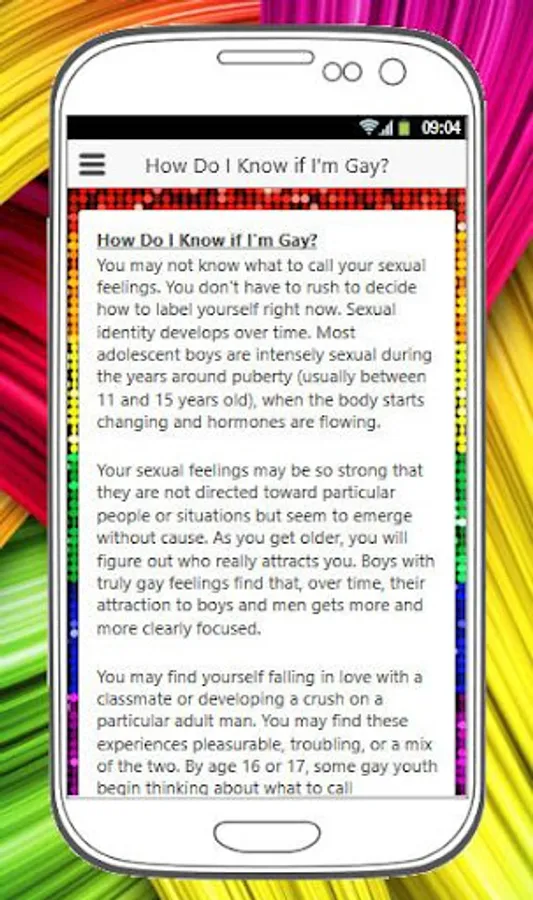
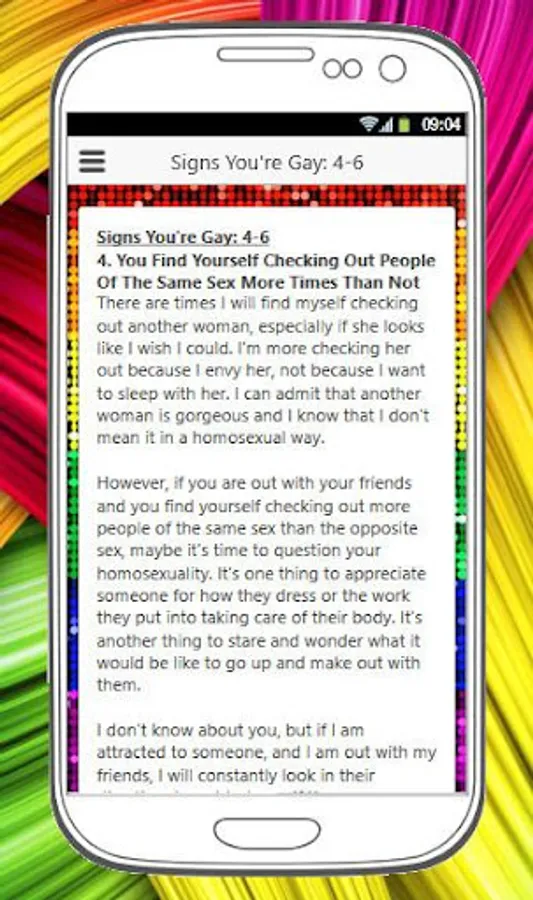
AM I GAY Screenshots
Tap to Rate: