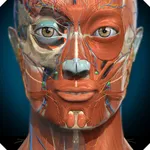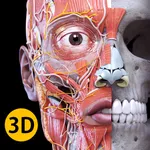
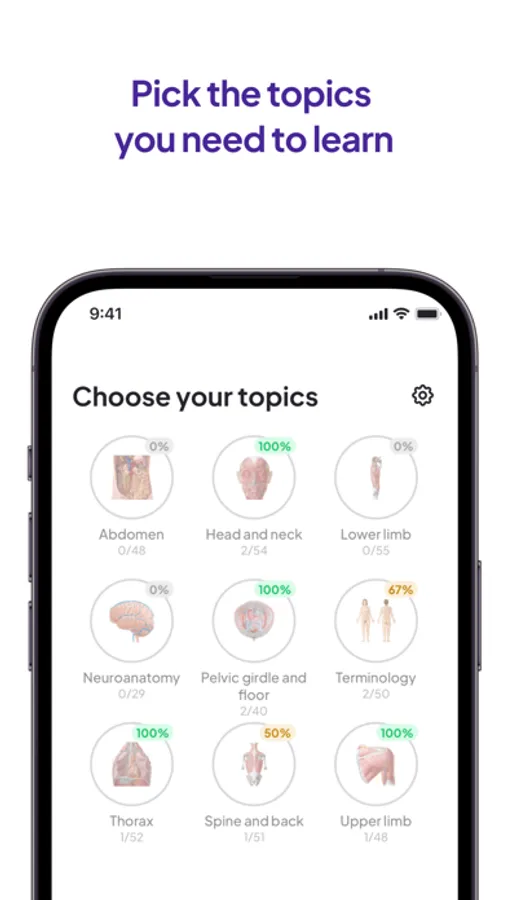
In this anatomy flashcard app, users review and memorize key anatomical structures through spaced repetition and visual highlighting. Includes images of bones, muscles, nerves, vessels, and key points.
AppRecs review analysis
AppRecs rating 4.4. Trustworthiness 66 out of 100. Review manipulation risk 30 out of 100. Based on a review sample analyzed.
★★★★☆
4.4
AppRecs Rating
Ratings breakdown
5 star
89%
4 star
7%
3 star
2%
2 star
1%
1 star
1%
What to know
✓
High user satisfaction
89% of sampled ratings are 5 stars
⚠
Low-content positive reviews
Many 5-star reviews use very limited vocabulary
About Daily Anatomy Flashcards
New topics, more content! Daily Anatomy Flashcards teaches healthcare students the 500 most important anatomical structures in a beginner-friendly format. The perfect entry into the world of anatomy!
*Reach your goals*
Starting to learn anatomy can be overwhelming, but it shouldn't be. Daily Anatomy can be used without any prior knowledge. It starts with the basics, and challenges your brain more and more over time. Learning with Daily Anatomy is not only about repetition. It introduces information in varying forms. Solving a problem in different ways helps you memorize information longer-term and finally be able to fully absorb it. Whether on your next exam, or in your medical professional career, all the anatomy structures will be at hand. No more thinking. Just knowing.
*What will you learn?*
With Daily Anatomy you learn all the important structures of human anatomy. This includes bones, muscles, nerves, vessels and specific points on the bones.
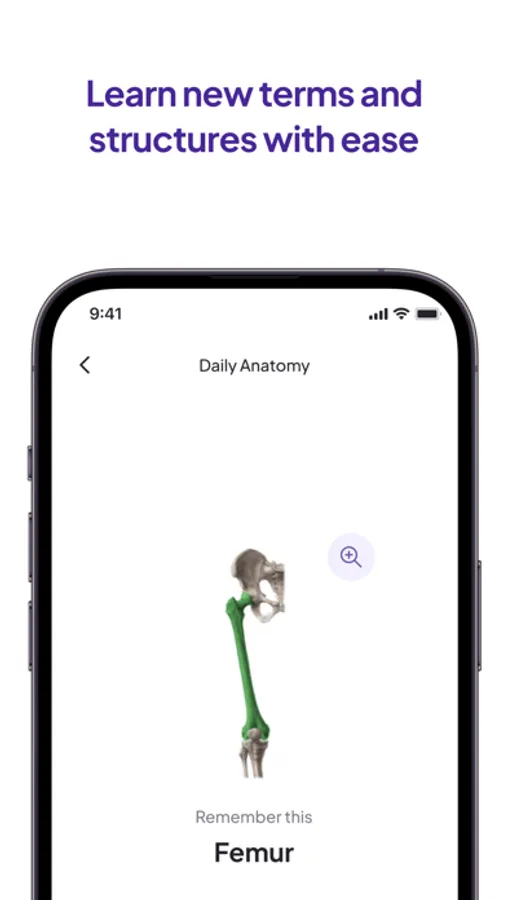
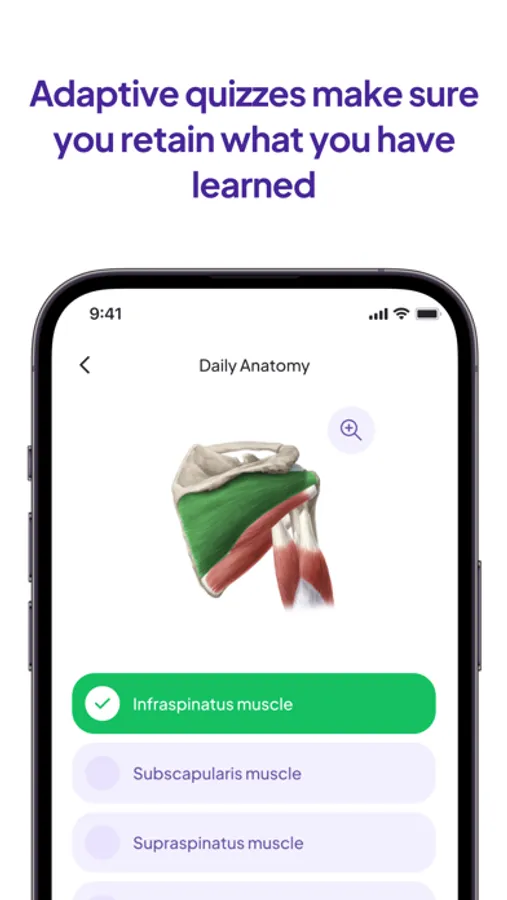
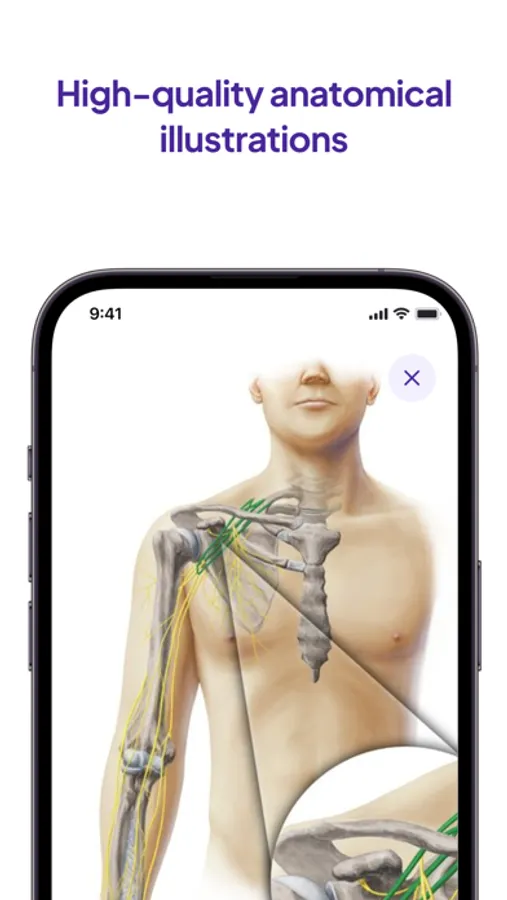
Instead of many thin arrows pointing at various structures, each structure is clearly highlighted in green in its entirety. This way you can easily identify and memorize both shape and location.
*How to stay motivated and not forget*
Whether you need to learn lists of information, or for instance, every muscle and bone in the human body including how they function together, there is a method really works to help you out. The bonus is that this method doesn't stress you out either because you get to take lots of breaks.
It's called spaced repetition, and it's the way to go for knowledge that sticks in your cranium.
By using spaced repetition, you work through a series of increasing intervals of time between studying what you've previously learned. This method utilizes the psychological spacing effect, which occurs when you are going back over information that you have already learned in order to remember it better. Spaced repetition works well for lists of items or new vocabularies such as medical terminology.
Daily Anatomy has built-in spaced repetition, so you learn as efficiently and effectively as you can.
*Reach your goals*
Starting to learn anatomy can be overwhelming, but it shouldn't be. Daily Anatomy can be used without any prior knowledge. It starts with the basics, and challenges your brain more and more over time. Learning with Daily Anatomy is not only about repetition. It introduces information in varying forms. Solving a problem in different ways helps you memorize information longer-term and finally be able to fully absorb it. Whether on your next exam, or in your medical professional career, all the anatomy structures will be at hand. No more thinking. Just knowing.
*What will you learn?*
With Daily Anatomy you learn all the important structures of human anatomy. This includes bones, muscles, nerves, vessels and specific points on the bones.
Instead of many thin arrows pointing at various structures, each structure is clearly highlighted in green in its entirety. This way you can easily identify and memorize both shape and location.
*How to stay motivated and not forget*
Whether you need to learn lists of information, or for instance, every muscle and bone in the human body including how they function together, there is a method really works to help you out. The bonus is that this method doesn't stress you out either because you get to take lots of breaks.
It's called spaced repetition, and it's the way to go for knowledge that sticks in your cranium.
By using spaced repetition, you work through a series of increasing intervals of time between studying what you've previously learned. This method utilizes the psychological spacing effect, which occurs when you are going back over information that you have already learned in order to remember it better. Spaced repetition works well for lists of items or new vocabularies such as medical terminology.
Daily Anatomy has built-in spaced repetition, so you learn as efficiently and effectively as you can.
Daily Anatomy Flashcards Screenshots
Tap to Rate:
Reviews for Daily Anatomy Flashcards
I cove this app
Good
This app is good because it helps with memory
Playful Otter74
Happy Nurse
Best App!