Updated March 2026
There are a lot of baby name apps out there. Most of them look pretty similar on the surface: swipe on names, match with your partner, done. But once you actually use them, the differences are huge. Some drown you in ads. Some can't even connect to your partner's phone. And some just show you the same 20 names over and over.
We downloaded and tested the most popular baby name apps, compared their features side by side, and checked what real users are saying in App Store reviews. Here's what we found.
Quick Comparison
Ratings from the iOS App Store as of March 2026.
 Baby Name Genius4.6 stars
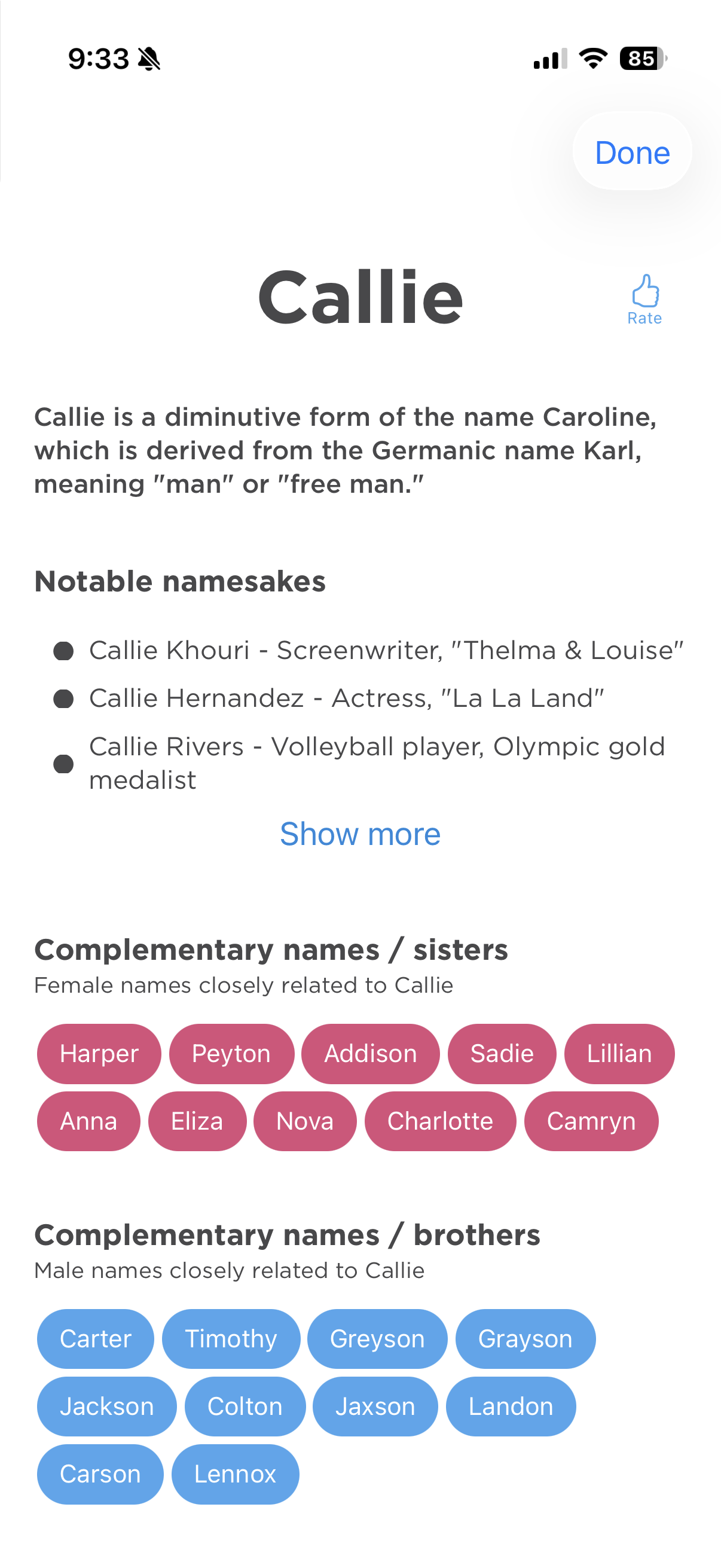
Best for: name research and data. Baby Name Genius goes deeper on individual names than the other apps here. Tap on "Oliver" and you don't just get "English origin, means olive tree." You get a popularity graph going back over 100 years (based on actual U.S. Census data), related names, name variants, and even real-world data like what professions and political leanings are associated with people named Oliver.
The swipe interface works well. When you match with a partner, the app shows agreement levels like "both love it" versus "worth discussing," rather than just a binary match. Each name also shows "complementary names" — names you're likely to enjoy if you like the current one, which helps you discover options you might not have thought of. There are over 30 themed name lists (Floral, Shakespeare, Mythology, etc.) and the popularity rankings let you browse names by year.
According to its App Store description, it's been featured in The New York Times, Good Morning America, and Freakonomics.
The catch: The database focuses on English-language names, so it's not the right pick if you need names from specific non-English traditions. A few advanced features require a $6.99 lifetime upgrade.

 Babyname4.1 stars
Babyname is one of the most popular baby name apps on the App Store. The core concept works: swipe right to like, swipe left to skip, connect with a partner via link or AirDrop. It's color-coded (blue for boys, pink for girls, purple for gender-neutral) and the swiping feels snappy.
But once you get past the first impression, problems start showing up. The biggest complaint in App Store reviews is name repetition. Reviewers report seeing the same names come back "5-6 times in a row" even after swiping left. The undo-swipe feature is locked behind a paywall, as are most of the name filters (nationality, "hipster names," celebrity names). The full unlock is $7.99/month.
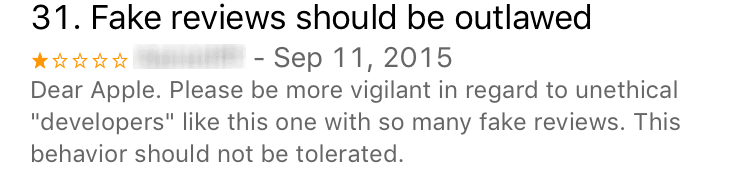
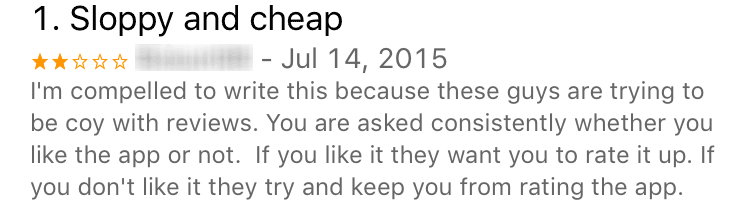
Partner syncing also comes up frequently in reviews. Multiple reviewers report being unable to link accounts at all. One wrote, "Won't let me and my husband link... purchased the highest level and gave money away."
When we tapped "Info" on a name, we got meaning, origin, and country. That's it. No popularity history, no related names, no namesakes.
Bottom line: If you want a popular, polished swipe experience, Babyname delivers that. But beyond swiping and partner matching, there isn't much depth: no popularity trends, no curated lists. And at $7.99/month for filters and undo, the price adds up quickly for what you get.

 Kinder4.5 stars
Kinder is a small indie app built by a solo developer, and it shows in both good and bad ways. The good: it's thoughtfully designed and organized around language-based name sets: English, Irish, Italian, French, Hebrew, Spanish, German, and more. If you know you want an Irish name or a Hebrew name, Kinder gets you there faster than the bigger apps.
The partner connection was recently redesigned to work via QR code, link, or code. Purchases are shared between connected partners, which is a nice touch that other apps don't do.
The bad: partner syncing is the #1 complaint in reviews. Multiple reviewers report that the connection doesn't work. One wrote: "Inviting your partner does nothing. Doesn't connect your accounts or even seem like it attempts to." According to the app's description, the name pool is around 20,000, smaller than some competitors. And at least one reviewer mentioned needing to swipe through hundreds of obscure names before hitting more common ones.
Each language pack is $0.99, or $4.99 for all of them. The free version gives you one set based on your location.
Beyond the language filter, though, Kinder doesn't give you much to work with: no popularity data, no name history, no themed lists. It's a straightforward swiper with a smaller pool.


 Baby Name Together4.5 stars
Baby Name Together tries to be the everything app: swiping, partner matching, name pronunciation, AI-powered suggestions, baby announcement cards, and a parent forum. It claims 30,000+ names from 15+ origin regions and recently added an AI name assistant.
In practice, the feature quantity comes at a cost. We saw ad banners on the swipe screen during testing. On Android especially, reviewers report ads every 30 seconds, including ads that play when checking a name's pronunciation or meaning. The free version is more limited than the description suggests: some reviewers report only being able to access around 1,200 boy names without paying, despite the "30,000+ names" claim. The full unlock is $7.99/month.
Stability is another theme in reviews: users mention freezing after searches, account creation failures, and data loss when switching devices. One reviewer wrote: "Does not let you add your partner or spouse. Defeats the entire purpose."
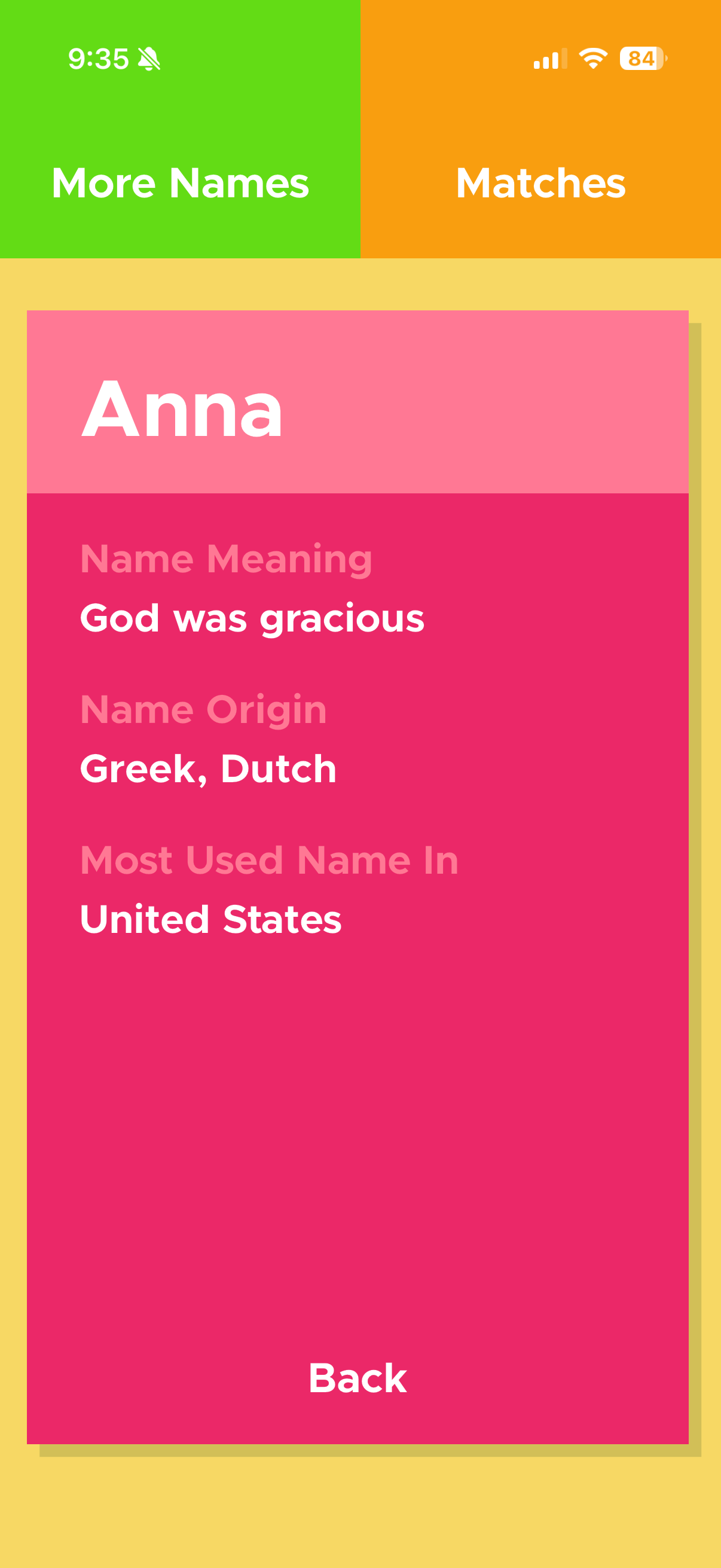
There's a long feature list, but in our testing the name data didn't go beyond basic origin and meaning. The swipe cards use a cursive italic font that's hard to read, and the layout has large gaps between content sections.
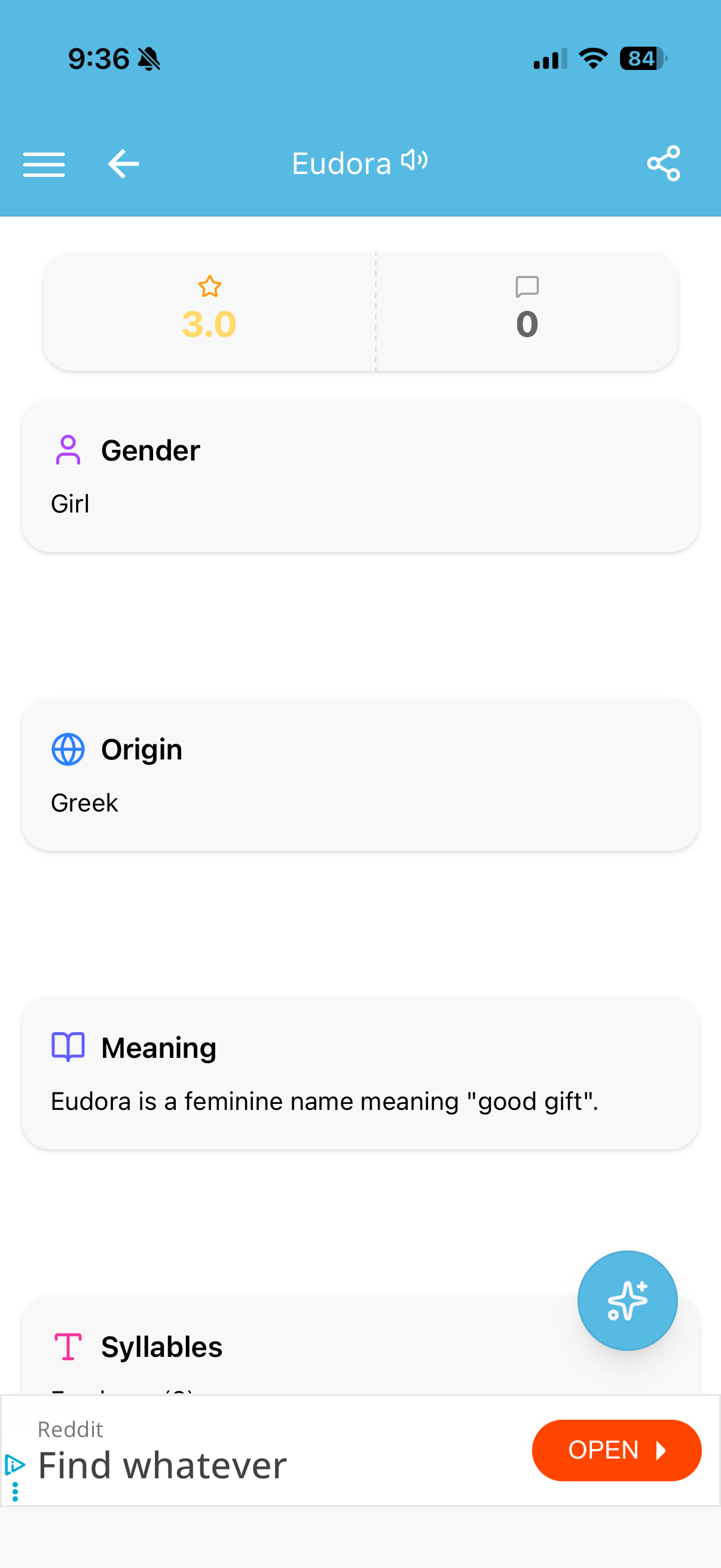
The detail screen shows gender, origin, and a one-line meaning, each in its own card with large empty gaps between them. Several reviewers have noted the gap between the app's advertised feature set and what's available without paying.

The Bottom Line
All four apps let you swipe on names and match with a partner. That part works roughly the same everywhere. The differences are in everything else, and honestly, most of these apps don't offer much beyond the swipe.
If you care most about name data and research, Baby Name Genius offers the most depth: Census popularity trends, real-world associations, and 30+ curated lists, with a one-time $6.99 unlock. If you want the most popular option, Babyname has a polished swipe experience, though the $7.99/month subscription adds up. If you need international names, Kinder's language-based organization gets you there faster. Baby Name Together has the longest feature list, but many features require the $7.99/month subscription to access.
One thing worth noting: partner syncing problems come up in reviews for all four apps. It's a frequent complaint for Babyname, Kinder, and Baby Name Together in particular. Worth reading recent reviews before you commit to one.
Frequently Asked Questions
What is the best baby name app?
It depends what you're looking for. Baby Name Genius has the highest iOS rating (4.6 stars) and goes the deepest on name data, including popularity trends from 100+ years of U.S. Census records, origins, meanings, and real-world associations. Babyname is one of the most popular options. Kinder is best for international names.
Is there a Tinder-like app for baby names?
Yes. Most popular baby name apps now use swipe-right-to-like, swipe-left-to-skip interfaces. Baby Name Genius, Babyname, Kinder, and Baby Name Together all have some form of swipe-based browsing. Baby Name Genius also lets you "love" a name (not just like it), which helps when you're reviewing your list later.
What baby name app lets you match with your partner?
All four apps reviewed here offer partner matching, but reliability varies. In App Store reviews, partner syncing issues are a frequent complaint across Babyname, Kinder, and Baby Name Together.
Are baby name apps free?
All of them are free to download. Babyname and Baby Name Together both charge $7.99/month for the full unlock. Baby Name Genius is a one-time $6.99 for lifetime access. Kinder charges $0.99 per language pack or $4.99 for all.
Why do baby name apps keep showing me the same names?
Name repetition is a common issue, especially in Babyname where it's the #1 complaint. This typically happens because the app cycles through its database and re-surfaces names you've already rejected. Baby Name Genius and Kinder tend to handle this better, though no app is completely immune to it.